What is Remediation?
For user level remediation, see "What is ULR (User Level Remedation)?"
Remediation, or data remediation, refers to any action taken to minimize the impact of sensitive data, protect sensitive information, or destroy or anonymize it to protect against and reduce the risk of a data breach or exfiltration.
This is a proactive way to address vulnerabilities, risks, and ensure data is secure and private, mitigating risks and adhering to regulations.
Example: Remediate Exposed Passwords
After performing a scan in Spirion Sensitive Data Platform, your scan results indicate a directory on a company laptop contains hundreds of passwords in plain text.
As a remediation you decide to redact all of the password text from the files in the offending directory.
The remediation action can be performed a number of different ways, such as:
- An automated action defined in a Scan Playbook (rules created by you or someone else that define what to do when scanning files and locations).
- A manual action in a Scan Playbook
- A manual override via the end user. See ULR (user level remediation).
Remediation within Spirion Sensitive Data Platform
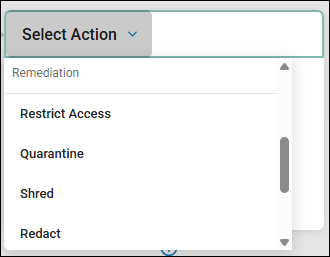
Scan Playbooks (or "Playbooks") list the following actions under the "Remediation" category:
- Restrict Access
- Quarantine
- Shred
- Redact
- Execute Script
- Take No Action
- Ignore
Of all of the options listed, the Remediated Risk tile in the SPIglass Dashboard displays the value of sensitive data that has been remediated via the Shred or Redact methods only.
Compensating Controls versus Remediation
Compensating Controls are actions applied to sensitive data discovered in your environment to mitigate risks.
These actions include the following:
- Restricted Access: Limiting who can view or interact with the data
- Script Execution: Running scripts to manage or remediate data
- Quarantine: Isolating sensitive data to prevent unauthorized access
- Ignore: Choosing not to act on certain sensitive data matches or sensitive data locations
Note: Not included here is Classification, User Action, Assign, Notify, MIP Label, Shred, React, Take No Action
- Compensating Controls are NOT the equivalent of Remediation actions
- Compensating Controls and Remdiation are mutually exclusive terms
- Data which has received the Remediation actions Shred or Redact are excluded from any chart, graph, or report which measures or captures sensitive data that has received Compensating Controls (that is, the following actions: Restricted Acccess, Script Excution, Quarantine, Ignore)
- Sensitive data which has received Compensating Controls actions is referred to as "Managed data." Managed data is sensitive data that has not been fully remediated, but it is not as vulnerable as data that has not been acted upon.